
Understanding Pelvic Floor PT: Beyond Postpartum Care
Hello Thrivers,
If you think "pelvic floor PT" is only for postpartum patients dealing with urinary leakage, you're not alone — it's one of the most common misconceptions we hear at Thrive Physical Therapy. While postpartum urinary incontinence is absolutely one reason to seek pelvic floor physical therapy, it's just one narrow slice of what this specialty actually treats.
This guide breaks down what pelvic floor dysfunction really means, who it affects, and when it's time to see a pelvic floor physical therapist near you.
What Does "Pelvic Floor PT" Actually Mean?
"Pelvic floor PT" is a bit of a misnomer. Physical therapists are movement specialists trained to care for the whole body — addressing dysfunctions in motor control, range of motion, and strength to help patients function and participate fully in their lives.
The pelvic floor is simply a group of muscles that, like any other muscle group, plays a role in that function. It isn't separate from the rest of the body — we're not treating "disembodied floating pelvises." What is different is that treating the pelvic floor requires specialized training in examination and treatment techniques.
So when you see a physical therapist for "pelvic floor PT," you're really seeing a physical therapist who has additional skills to assess and treat the pelvic floor as part of your whole-body care.
The Pelvic Floor: Three Layers, Five Key Jobs
The pelvic floor consists of three layers of muscle that work together to:
Maintain bowel and bladder continence
Allow for bowel and bladder evacuation
Support sexual function and sensation
Support the pelvic organs
Contribute to core and postural stability
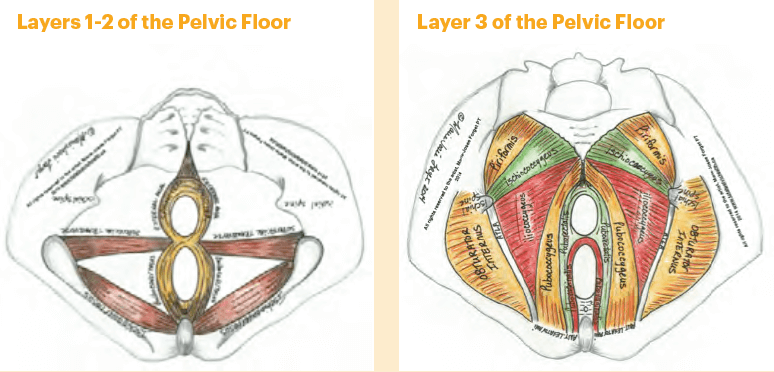
Pelvic Floor model by Marie Josee Forget (www.totalpelvichealth.ca)
Common Symptoms of Pelvic Floor Dysfunction
Because these muscles do so much, dysfunction can show up in many different ways — and the causes are just as varied. Pelvic floor issues can stem from infection, hormonal changes, past trauma, pregnancy, nerve injury, autoimmune disease, chronic pain conditions, and more.
Symptoms and conditions linked to pelvic floor dysfunction include:
Loss of bowel or bladder control
Constipation
Urinary or bowel urgency and frequency
Pelvic pain
Diminished sexual sensation or pain with intercourse
Pelvic organ prolapse
Lumbo-pelvic-hip control issues
In other words: there's a lot more to pelvic floor PT than postpartum leaking — even though that's included too.
Conditions We Treat at Thrive Physical Therapy
Our pelvic floor physical therapists treat a wide range of conditions, including:
Urinary urgency/frequency
Bowel urgency/frequency
Bowel or bladder incontinence
Bladder pain syndrome
Chronic constipation
Pelvic organ prolapse
Postpartum return-to-activity support
Chronic pelvic pain
Pain with intercourse
Low back pain
Hip pain
Coccyx (tailbone) pain
Who Is Pelvic Floor PT For?
Given how broad this list is, the real question isn't "Who is a good candidate for pelvic floor PT?" — it's "Who isn't?"
If you're experiencing any of the symptoms above, pelvic floor physical therapy may help — regardless of your age, gender, or whether you've given birth.
Frequently Asked Questions About Pelvic Floor Physical Therapy
Is pelvic floor PT only for women?
No. While pelvic floor PT is often associated with postpartum recovery, anyone with a pelvic floor — including men and non-birthing individuals — can experience pelvic floor dysfunction. Men commonly seek pelvic floor PT for issues like urinary urgency, constipation, pelvic pain, or pain after prostate surgery.
Do I need a referral to see a pelvic floor physical therapist?
In many states, no — physical therapists can be seen through direct access, meaning you can schedule an evaluation without a physician referral. However, requirements vary by state and insurance plan, so it's worth checking with your provider or calling our office to confirm what applies to you.
What happens during a pelvic floor PT evaluation?
A pelvic floor evaluation typically includes a discussion of your symptoms and health history, an assessment of posture, breathing, and core/hip mobility, and — when appropriate and with your consent — an internal or external pelvic floor muscle assessment. Every evaluation is tailored to your comfort level and goals.
Is pelvic floor PT only for people who've had a baby?
No. Postpartum recovery is one common reason people seek pelvic floor PT, but it also treats chronic constipation, pelvic pain, painful intercourse, urinary or bowel urgency, pelvic organ prolapse, low back pain, hip pain, and tailbone pain — regardless of pregnancy history.
How do I know if my symptoms are related to my pelvic floor?
Symptoms like urinary or bowel leakage, urgency or frequency, constipation, pelvic pain, pain with intercourse, or unexplained low back or hip pain can all be signs of pelvic floor dysfunction. If you're unsure, a pelvic floor physical therapist can help determine whether your symptoms are connected during an initial evaluation.
How many pelvic floor PT sessions will I need?
This varies widely depending on the condition, its severity, and how long you've had symptoms. Some patients see improvement in a few sessions, while more complex or long-standing issues may take several months of care. Your therapist will give you a personalized plan of care after your evaluation.
Ready to Get Started?
If any of this sounds familiar, our pelvic floor physical therapists at Thrive PT are here to help. Please contact the office at info@thrivept.com or submit your insurance information and appointment request through our secure online portal by clicking HERE.